
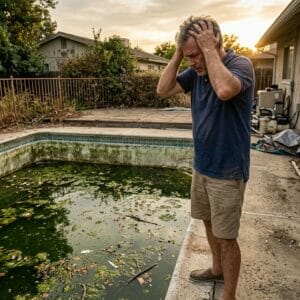
 Owning a residential swimming pool means managing a living biological system that changes every day based on weather, usage, chemistry, and equipment health.
I bought my house in Litchfield Park, Arizona, with a 22,000-gallon in-ground pool and assumed it would be like owning a large bathtub — fill it up, add some chlorine, and float.
That fantasy lasted about three weeks before the water turned green, the pump started making noise, and I realized I had a $50,000+ investment in my backyard that I knew nothing about maintaining.
This Swimming Pool Reality guide covers what I wish someone had told me before I bought a home with a pool. The same thing goes for those contemplating installing a swimming pool.
This is not a marketing brochure version of pool ownership, but the actual numbers, the real-time commitment, and the honest cost breakdown.
The good news: once you understand the reality, maintaining a pool takes about 15 minutes per week and $30–$50 per month.
The bad news: ignoring it for even two weeks can turn a clear pool into a green swamp that costs $60–$200 to recover.
Accept That 95% of Pool Ownership Is Maintenance, Not Swimming
New pool owners picture themselves floating on a raft every weekend. That part is real — and it’s worth every minute. But that floating time represents roughly 5% of your total interaction with the pool. The other 95% is testing water, brushing walls, emptying baskets, monitoring equipment, and buying chemicals. That ratio sounds intimidating until you realize the maintenance part condenses into a single 15-minute session per week once you learn the routine.
| Pool Ownership Activity | Time Per Week | Annual Hours | Reality Check |
|---|---|---|---|
| Weekly maintenance (skim, brush, test, adjust) | 15–20 min | 13–17 hrs | This is the non-negotiable minimum — skip it, and problems multiply |
| Equipment checks (pump, filter, heater) | 2–5 min | 2–4 hrs | A quick glance at the pressure gauge and listening to the pump |
| Seasonal tasks (opening, winterizing, deep cleans) | Varies | 6–10 hrs | Concentrated effort in spring and fall — an afternoon each |
| Unexpected repairs and recoveries | Varies | 4–8 hrs | Green pool recovery, equipment swap, post-storm cleanup |
| Total annual maintenance time | 25–39 hrs | Less than one full work week per year for a $50,000+ asset |
The DIY approach requires treating the pool like the major investment it is — not a decoration. Twenty-five to 39 hours per year sounds like a lot until you compare it to lawn care, car maintenance, or any other property responsibility. The difference is that a neglected lawn looks bad; a neglected pool becomes a health hazard and an expensive fix within days.
Budget for the Real Monthly Cost of Pool Ownership
Nobody hands you a realistic cost sheet when you buy a house with a pool. The real estate agent mentions “low maintenance,” the inspector checks a few boxes, and you sign the papers, assuming it costs $20 a month. Here’s what I actually spend to maintain my pool in Arizona — and what you should plan for, regardless of climate.
| Expense Category | Monthly Cost (DIY) | Annual Cost (DIY) | Notes |
|---|---|---|---|
| Chemicals (chlorine tablets, acid, shock, CYA) | $25–$40 | $300–$480 | Higher in summer when the heat burns chlorine faster |
| Electricity (pump runtime) | $30–$80 | $360–$960 | Variable-speed pumps cut this by 50–70% vs single-speed |
| Water (evaporation replacement + backwash) | $10–$30 | $120–$360 | Desert climates lose 1/4–1/2 inch per day in summer |
| Replacement parts (baskets, O-rings, hoses) | $5–$15 | $60–$180 | Small parts that wear out from UV and chemical exposure |
| Test kit refills | $5–$7 | $60–$80 | Liquid drop reagents last 1–2 seasons; replace annually |
| Total monthly (DIY) | $75–$170 | $900–$2,060 | |
| Professional service (for comparison) | $175–$320 | $2,100–$3,840 | Includes $100–$150/month service fee + chemicals + your electricity/water |
Before you call a professional pool service and add $100–$150 per month to that total, understand that every task they perform during a weekly visit — test the water, add chlorine, brush the walls, empty the basket — is something you can learn in a single afternoon. I save $1,200–$1,800 per year by doing it myself, and the quality is better because nobody cares about my pool more than I do. A service tech with 40 pools on their route spends 5–10 minutes at each stop. I spend 15 minutes once a week, and my water is consistently cleaner.
Prepare for Climate-Specific Challenges
Pool maintenance intensity varies dramatically by climate. I maintain my pool in Arizona, where the Thermal Sanitization Stress Period runs from May through September, pushing every system to its limits. Pool owners in the Southeast deal with humidity and rain; Northern owners deal with freeze cycles and winterization. The specific challenges differ, but every climate has its version of “the hard months.”
| Climate Challenge | Impact on Your Pool | What It Costs You | How to Manage It |
|---|---|---|---|
| Extreme heat (100°F+) | Chlorine burns off 2–3x faster; algae growth accelerates | $15–$25/month extra in chemicals | Run pump during peak sun hours; increase chlorine dosing; maintain CYA at 30–50 ppm |
| High evaporation (desert) | Pool loses 1/4–1/2 inch of water daily; auto-leveler runs constantly | $10–$30/month in water | Check water level every 2–3 days; verify auto-leveler valve shuts off properly |
| Dust storms/monsoons | Fine silt clogs the filter in hours; organic debris consumes chlorine | $10–$20 per storm (shock + extra backwash water) | Pre-skim before running pump; shock after storms; storm maintenance and cleaning routines |
| Freeze cycles (Northern climates) | Frozen pipes crack plumbing; ice damages the skimmer body | $200–$500 if pipes burst | Winterize equipment; install skimmer plugs; follow a strict winterization protocol |
| Heavy rain/humidity | Dilutes chemicals; raises water level above skimmer; adds contaminants | $5–$15 to rebalance after heavy rain | Test and adjust chemistry within 24 hours of any major rain event |
The Arizona-specific challenge I underestimated most was evaporation. My pool loses roughly 15,000–20,000 gallons of water per summer just to evaporation — that’s filling the pool nearly halfway over from scratch. The auto-leveler valve refills it automatically from the garden hose, but if that valve sticks open, you’re flooding the yard. If it sticks closed, the water drops below the skimmer, and the pump sucks air, overheats, and damages the mechanical seal. I check my auto-leveler valve every week during the summer. It takes 10 seconds and has saved me from both failure modes.
Recognize When You’re Being Upsold at the Pool Store
Walking into a pool supply store with a water sample as a new owner is like walking into a car dealership without knowing what you’re looking for. The store runs your sample through their testing system and hands you a printout with 8–10 products to buy. Some of those products are legitimate. Some are unnecessary add-ons that pad the receipt.
- What you actually need 95% of the time: Chlorine tablets, muriatic acid for pH adjustment, and occasionally shock. That’s it for weekly maintenance. Three products.
- What they’ll try to sell you: Phosphate removers ($15–$25), enzyme treatments ($20–$30), clarifiers ($10–$15), algae preventers ($15–$20), and “water polishers” that do the same thing your filter already does for free.
- When specialty products actually matter: Phosphate removers have a place when phosphate levels exceed 500 ppb and you’re battling recurring algae despite good chlorine levels. Clarifiers help after a cloudy-water recovery. But these are emergency tools, not weekly purchases.
The day I bought a Taylor K-2006 liquid drop test kit and started testing my own water was the day I stopped buying products I didn’t need. When you know your own numbers — free chlorine, pH, alkalinity, calcium hardness, CYA — nobody can sell you something your water doesn’t actually require. That $80 test kit paid for itself in the first two months by eliminating $40–$60 in unnecessary store-recommended products.
Anticipate the Five Mistakes Every New Pool Owner Makes
I made every single one of these mistakes during my first two years. Every experienced pool owner I’ve talked to made the same ones. They’re practically a rite of passage — but you can skip most of them if you know what’s coming.
| Mistake | What Happens | What It Costs | How to Avoid It |
|---|---|---|---|
| Ignoring CYA buildup from stabilized tablets | Chlorine becomes “locked” above 80–100 ppm CYA — tests high but kills nothing | $30–$80 (partial drain + refill) | Test CYA monthly; alternate between stabilized tabs and liquid chlorine |
| Running the pump only at night to save electricity | Algae thrives during daytime heat with no circulation or chlorine distribution | $15–$30 (shock to recover) | Run pump during peak sun hours (9 AM–5 PM) when biological demand is highest |
| Skipping weekly brushing because the water “looks fine.” | Invisible biofilm builds on walls; it becomes visible as an algae bloom within days | $10–$60 (depending on severity) | Brush walls and steps every week, regardless of appearance — 3 minutes total |
| Using cheap test strips instead of a liquid drop kit | Inaccurate readings lead to over- or under-dosing chemicals | $20–$50 in wasted chemicals per season | Invest $80 in a Taylor K-2006 or equivalent reagent kit |
| Waiting too long to clean the filter | Pump strains against back-pressure; heater shuts off; water clarity drops | $0 (if caught early) to $200+ (burned pump motor) | Check filter pressure weekly; clean when 8–10 PSI above baseline |
The CYA mistake cost me the most. Three summers of using only stabilized chlorine tablets pushed my CYA to 140 ppm. My chlorine tested at 4 ppm, but couldn’t kill a single algae cell because it was chemically bound to the excess stabilizer. I had to drain and refill the pool and refill with fresh water to bring CYA back into the 30–50 ppm range. To rebalance the water chemistries after that drain, I tested every day for two weeks while the fresh water diluted and stabilized. Nobody warned me about CYA, and no pool store ever mentioned it — they just kept selling me more stabilized tablets.
Embrace the Weekly Routine That Makes It All Worth It
The most cost-effective remediation is building a consistent 15-minute weekly routine and sticking to it. Every pool disaster I’ve experienced — green water, cloudy water, noisy pump, stained plaster — started because I skipped a week or two of basic maintenance. Every good stretch of clear, swim-ready water came from doing the same simple tasks on the same day every week.
My Saturday morning routine: skim the surface (2 min), empty baskets (1 min), brush walls and steps (3 min), test water chemistry (4 min), adjust chemicals (2 min), check filter pressure (30 sec). Total time: under 15 minutes. Total monthly chemical cost: $30–$50. The complete DIY maintenance guide walks through every step with the exact products and measurements I use.
Here’s the part that surprised me: I actually look forward to it now. There’s something satisfying about walking out on a quiet Saturday morning, testing the water, and confirming that everything is dialed in. It connects me to the house, the yard, the investment. My kids get a safe, clean pool every weekend because I gave it 15 minutes of attention. That’s the reality nobody talks about — it’s not just work, it’s ownership in the truest sense.
Frequently Asked Questions About Pool Ownership Reality
Is owning a pool actually worth the work?
A pool adds $20,000–$50,000 to a home’s value in warm-climate markets and provides a private recreational space that no gym membership or community pool can replicate. The weekly maintenance commitment is 15 minutes, and the monthly cost runs $75–$170 for DIY owners. Whether that’s “worth it” depends on how much your family will use it — but in Arizona, where swimming season runs 7–8 months per year, my pool has been the best investment in the house after the roof.
How much does it really cost to maintain a pool per month?
DIY owners should budget $75–$170 per month total (chemicals, electricity, water, parts). Professional service adds $100–$150 on top of the electricity and water you’re already paying, bringing the total to $175–$320 per month. The biggest variable is electricity — a single-speed pump running 8–10 hours daily costs $50–$80/month, while a variable-speed pump doing the same job costs $20–$35/month.
What is the biggest surprise for new pool owners?
Evaporation and chemical consumption during summer heat. New owners consistently underestimate how much water a pool loses to evaporation (1/4–1/2 inch daily in hot climates) and how fast the sun destroys chlorine without adequate CYA stabilizer. The second biggest surprise is that most pool problems are caused by circulation or filtration failures, not chemistry — fixing the equipment usually fixes the water.
Do I need to be a chemist to maintain my own pool?
You need to read a color chart and follow basic instructions — the same skill level as following a recipe. A liquid drop test kit gives you five numbers (chlorine, pH, alkalinity, calcium, CYA). Each number has a target range. If a number is outside the range, you add a specific product in a specific amount. The entire testing process takes 3–5 minutes, and the math is printed on every chemical container.
What happens if I ignore my pool for a month?
Chlorine drops to zero within 3–5 days without replenishment. Algae colonizes within a week. In two weeks, the water is green, and the filter is overwhelmed. By a month, you’re looking at a full algae takeover (swamp water), potential equipment damage from running a clogged system, and a recovery cost of $60–$200 in chemicals plus 5–7 days of intensive treatment. A single month of neglect undoes months of good maintenance.
Should I fire my pool service and do it myself?
If you’re willing to spend 15 minutes per week learning and doing the basics, yes. The savings run $1,200–$1,800 per year, and most DIY owners report cleaner water than what their service provided — because you test and adjust for your specific pool, not a 5-minute drive-by. Start by learning to buy your own supplies online (30–50% cheaper than retail stores) and following a weekly routine. Keep the professional’s number for equipment repairs and plumbing issues you can’t safely handle yourself.
I hate my pool — is that normal?
Completely normal, especially in the first year or two. Pool frustration almost always traces back to one of two things: an undiagnosed equipment problem that makes chemistry impossible to control, or a lack of routine that turns every pool interaction into crisis mode. Read the improving your weekly pool maintenance routine — the fix is usually simpler than you think. I hated mine for the first 18 months until I learned the CYA issue was sabotaging everything else I tried.